Modern Improv Quilting: How I Became an Improv Modern Quilter
Updated: 6 days ago
I learned to sew when I was 11, in a little class in Oregon where I made a pillowcase. Then came a few fits and starts with skirts in the 1980s, but sewing never really stuck.
Honestly, most times I pulled out the sewing machine, threaded it, and tried to sew, the bobbin thread became so tangled that it stopped me before I got anywhere.
I assumed I was doing something wrong.

It turns out the problem was the machine.
I didn’t discover that until years later, after making the substantial investment in a real sewing machine made for quilting. Sometimes buying better supplies is an attempt to solve a problem that more practice would solve. (More on where that line falls in what painting supplies you actually need) But sometimes the tool really is the problem.
In this case, the investment was warranted (I love you, my Juki). It changed everything.
That new quilting machine didn't instantly turn me into a technically accomplished seamstress. But it did give me a reliable way to explore, and eventually helped me discover the fun and freedom of modern improv quilting.
I began making brightly colored log cabin blocks by following tutorials. I had no idea what I was doing, but I had always been drawn to beautiful fabric. Soon I was learning about jelly rolls and charm packs, making trips to the fabric store, and starting a scrap box.
I ended up with about 12 log cabin blocks, all in varying sizes, with no idea what to do with them next.

I still have them. They’re in a work-in-progress box, waiting. Someday I may surround them with Kona white, bind them together, and turn them into a baby quilt.
Or they may wait a while longer.
Either way, they had already done something important: the block experiment helped me discover how much I loved working with fabric.
Then I Tried to Make the Corners Meet
Before discovering log cabin blocks, I had attempted to make a patchwork baby blanket for my son. The measurements were off by mere millimeters, but those millimeters accumulated. The squares didn’t line up. The corners didn’t meet. Nothing quite fit together the way it was supposed to and it was highly frustrating.
If that was quilting, I thought, perhaps I wasn’t cut out for it.
Then I discovered wonky log cabin blocks.
The word wonky unlocked the door.
Suddenly, those odd shapes and uneven angles weren’t problems I had to correct before I could keep going. I could work with them. I could cut a piece at an unexpected angle, attach another scrap, turn the block, and build outward.
The discovery brought possibility.
I loved the tactile experience of fabric. I loved putting colors and patterns together in combinations I hadn’t seen before. I could stack, cut, rearrange, and mix scraps for hours.
Purple and black. Metallic dots with daisies. Fabrics gathered that had no apparent business being together until they suddenly worked.
Now I had a way to connect them that accommodated odd shapes and uneven lines. It was really fun.
What Is Modern Quilting—and How Is It Different from Improv Quilting?
I often call myself a modern quilter, but modern quilting and improv quilting are not exactly the same thing.
So, what is modern quilting?

Modern quilting generally describes an aesthetic. Modern quilts often use contemporary colors, bold graphics, strong lines, negative space, and updated geometric patterns. Some are made from traditional patterns interpreted in a new way. Big and bold.
And despite the name, modern quilting can be exceptionally precise.
Improv quilting describes the process more than the finished appearance. Instead of following a fixed pattern, the quilter responds to the fabric and the composition as they develop. Pieces may be cut without templates, blocks may vary in size, and decisions are made along the way.
A quilt can be modern without being improvised. An improv quilt can have a modern appearance, but the two terms aren’t interchangeable.
For me, modern improv quilting offered the best of both. I loved the contemporary colors and compositions of modern quilting, but it was the improv process that gave me freedom.
I didn’t need a pattern? Sign me up.

I could begin with one scrap and decide what came next by looking at what was in front of me. I could change direction as I worked. I didn’t have to know the finished dimensions before I began.
I could follow the sewing where it took me.
Start With One Scrap
Suppose I want to make a pillow for a friend.
I might begin with her favorite color, then find one scrap of fabric that seems right. From there, I spend an hour going through what I already have, mixing and matching pieces with that original scrap. My scraps are organized by size. Smaller scraps are organized further by color.
One fabric suggests another. A color needs something quieter beside it. A strip gets cut down, turned, or used somewhere I hadn’t expected. I build outward, making one small decision at a time. I usually try to throw something random in (color or print) for additional interest.
That is part of what makes improv quilting so appealing to me. I’m not executing someone else’s complete plan. I’m solving a visual puzzle as it develops.
It also challenges me to use what I have. An oddly shaped scrap is not necessarily waste. Its size and shape become the next creative constraint.
The quilted piece doesn’t even have to become a pillow. It could become a runner, wall hanging, placemat, coaster, or something I haven’t thought of yet.
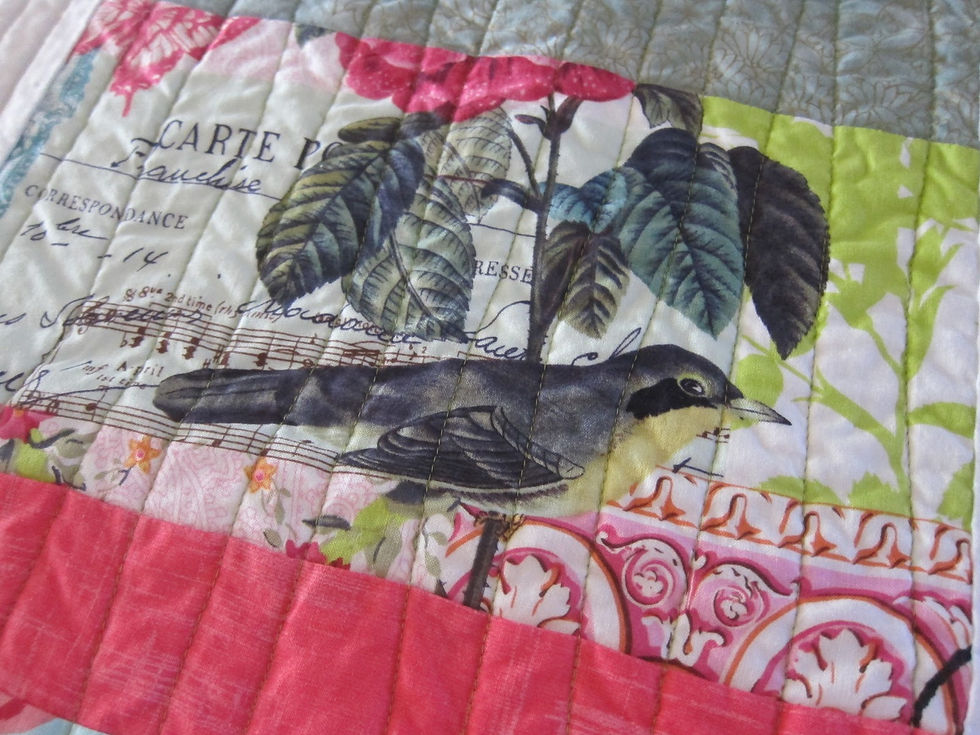
The first project I completed was a runner for my dining room table. It could be any size I wanted. I found fabric pieces I liked and sewed them together. Then I made a quilt sandwich and quilted it in lines.
No free-motion quilting required (which is a skill I don’t particularly want to learn). The straight lines looked good. The runner was useful. And I had made it myself.
And I was in love.
Permission Is Something You Practice
We often talk about creative permission as though it’s a declaration we make once:
I give myself permission to be a beginner.
I give myself permission to make something imperfect. (When that permission is hard to give yourself, the resistance has a name: art guilt.)
But you can give yourself permission to begin and still give up halfway through.
Real permission is an ongoing conversation.
You may have to talk yourself through the crooked seam, the ugly color choice, and the moment when the piece in front of you doesn’t resemble what you pictured in your head. You may need to renew that permission whenever you compare your work with someone else’s or discover another thing you don’t know how to do.
Being a beginner means you haven’t learned something yet. It does not mean you can’t make something worthwhile while you’re learning.
If a highly experienced quilter inspected some of my seams, she might conclude that I had done them incorrectly. Traditional quilting often places a high value on precision,
matching corners, and technically correct construction. I respect the skill that requires.

I just didn’t need to master all of it before I was allowed to make something beautiful and personal.
Improv quilting gave me permission to explore a new medium. Permission to be bad at parts of it. Permission to use what I already had. Permission to ignore certain techniques, at least for now. Permission to challenge myself when I wanted the work to grow.
Most importantly, it gave me permission to make quilting and this art form my own.
Permission isn’t the absence of standards. It is the freedom to decide which standards serve the work you want to make.
Sometimes permission means lowering the bar enough to begin. Sometimes it means challenging yourself to learn something difficult. Sometimes it means continuing when an imperfect seam gives you an excuse to stop. That excuse-to-stop moment is often artist block in disguise.
Permission isn’t merely something you give yourself.

It’s something you practice.
That was the possibility I found In modern improv quilting: I could respect the skill and precision of other quilters without requiring myself to create in exactly the same way.
Learn What Helps the Work Grow
Working without a pattern doesn’t mean skill is irrelevant. There is a difference between rejecting every technical practice and choosing which skills matter to the work you want to make.
I still can’t sew or appliqué a curve. I’m not especially interested in learning about bias or mastering free-motion quilting. Those skills may matter deeply to someone else’s work, but they haven’t been necessary for mine.
Binding was different.
I wanted to know how to bind a quilt well because I didn’t want my lack of knowledge to limit how I could finish a project. So I learned it—and now I love binding, even though many quilters consider it one of the hardest or most tedious parts.
Binding is like putting a frame on a canvas. It completes the work.
That is the kind of technical challenge I’m willing to pursue: one connected to something I care about making.
You don’t have to master an entire discipline before you’re allowed to participate in it. Learn what you need as the work requires it—or as your curiosity and ambition grow.
Why Quilting Finally Stuck
A reliable machine removed the mechanical friction. Improv quilting removed much of the perfection friction.
Becoming a modern quilter also gave me room to approach fabric as an artist. I could think in terms of color, line, composition, scale, and contrast. Not simply whether I was following the quilting 'rules' of pattern size and whether my points lined up (because they didn't).
But quilting also fit the way I naturally like to create.
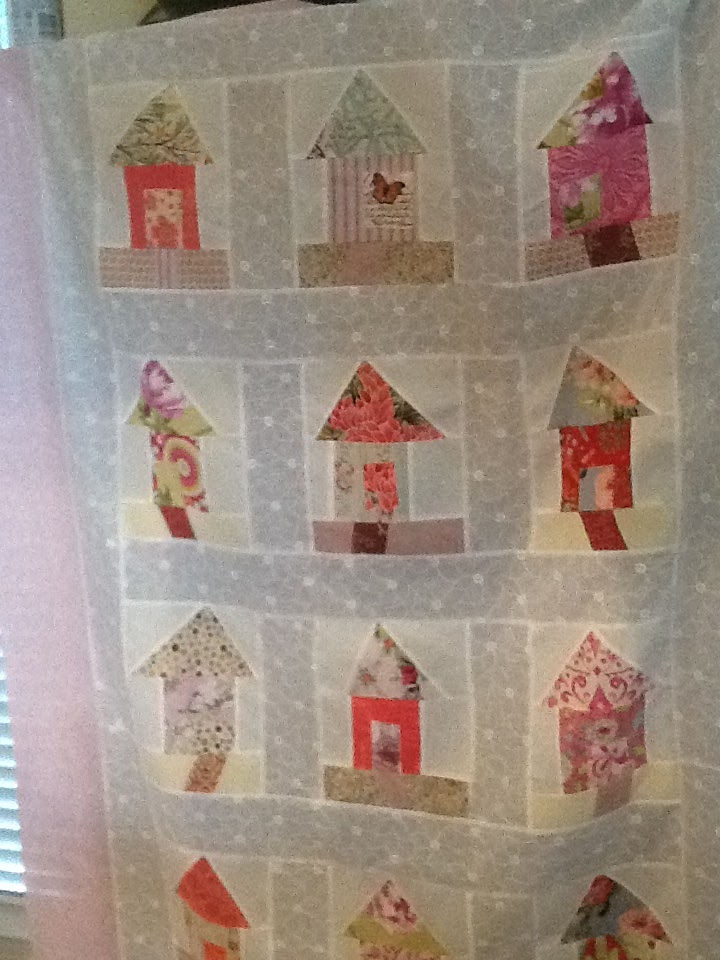
I didn’t have to commit to a predetermined size. I could make small decisions that gradually developed into something larger. I could work with color and pattern, respond instead of execute, not follow a pattern, and combine pieces in ways that felt surprising and personal.
Quilting also gives me something different from painting and collage. It allows me to work large and create utilitarian art.
A runner can lie across a dining room table. A pillow can live on a friend’s sofa. A quilt can cover a bed or wrap around someone you love.
It is art that gets used.
At the same time, it still gives me an enormous field for exploration. There are always new combinations, new constraints, and new ways to use what I already have.
That (not technical perfection)is what kept me coming back.
Your First Quilt Can Be a Coaster
If you’re intrigued by quilting but intimidated by the precision, vocabulary, equipment, or thought of committing to an entire bed quilt, don’t begin there.
Begin with one scrap of fabric you like.
Add another piece. Sew a semi-straight line. Trim it. Turn it. Add something unexpected. Keep building until you have one small block.
Then turn it into a coaster. This same start-tiny logic works for any creative comeback after a break.
You don’t need to know whether you’ll become a quilter. You don’t need an elaborate pattern or a perfectly coordinated fabric collection. You don’t need to master curves, appliqué, garment construction, or free-motion quilting first.
You need a machine that works, a few pieces of fabric, and enough permission to find out what might happen.
Your corners may not meet. Your seams may not impress the quilting police. Your first block may be too crooked, too busy, or too strange.
But it will be yours.
And it may open a door you didn’t know was there.
I still have those first 12 mismatched blocks in my WIP box. Someday they may become a baby quilt, bordered in Kona white and finished with the binding I now know how to make.
But even if they never do, they were not a failed project.
They showed me that I could be a quilter before I knew how to make everything line up.
Want an easy way to try modern improv quilting, or any other art? I created a 5-Day Creative Challenge, a way to plan and ease your way into learning any art or getting back into creating after taking a break. Sign up here.

Comments